
When AI answers outrun your SEO dashboard
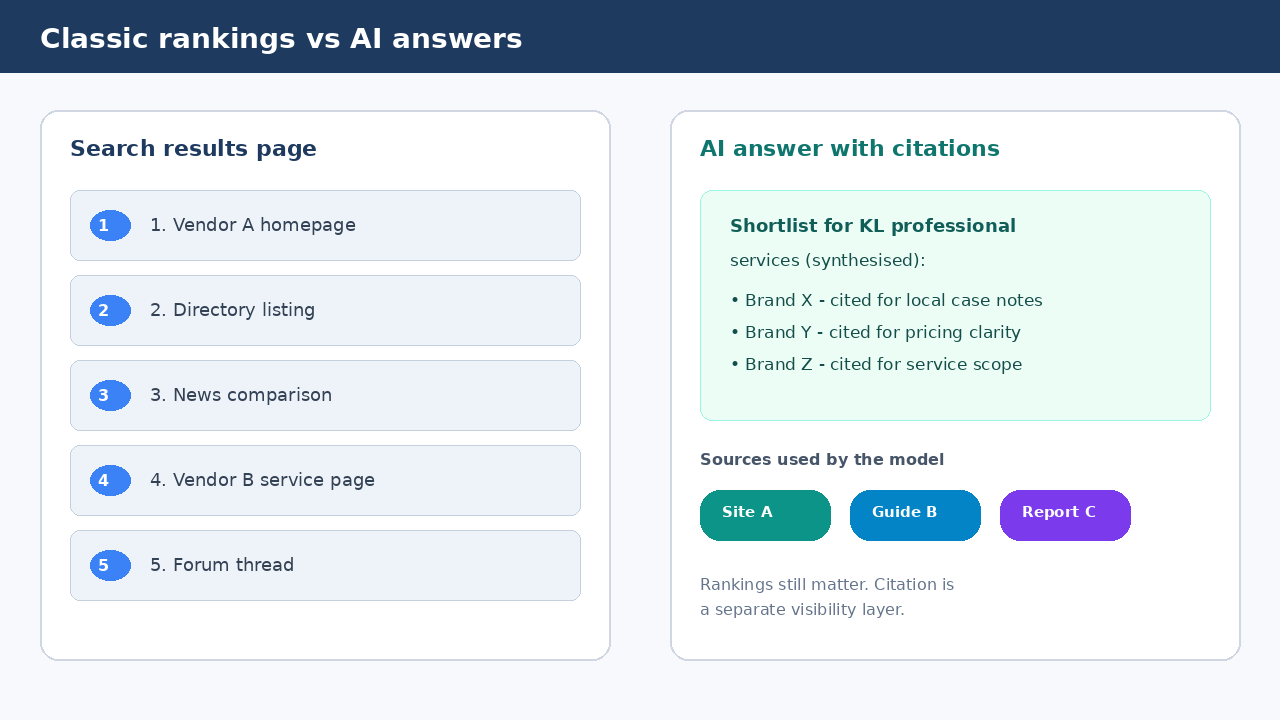
Most teams still open a ranking report and call it progress. Positions look stable, a few pages climb, traffic from Google looks… fine. Then a prospect says they asked ChatGPT or Gemini for a shortlist of providers in Malaysia and your brand never came up. Or worse, it did, with the wrong services attached. Classic SEO reports do not catch that gap. They measure blue links. Buyers are increasingly reading AI features in Search and chat-style answers first.
Why ranking reports under-explain demand now
Search still starts on Google for a lot of people. That has not vanished. What changed is the last mile. Some sessions end inside a summarised answer. A chunk of research never becomes a click you can attribute neatly. Industry trackers have been writing about this rise of zero-click searches for a while.
So a healthy SEO KL dashboard can sit next to a quiet pipeline and both can be true. You ranked. You just were not the source the model preferred when someone asked for a local shortlist. That is awkward for reporting, because “we were not cited” rarely shows up as a clear line item beside impressions and average position.
Technical hygiene, useful pages, and credible mentions still matter. Models lean on sources that already look coherent on the open web. The missing piece is whether your content is extractable, consistent, and worth citing when prompts get specific.
What GEO is actually trying to improve
Generative Engine Optimisation (GEO) is a clunky label for a simple goal: show up accurately when AI systems answer category questions. Not “rank number one for every keyword.” More like: when someone asks for help, does the model name you, describe you correctly, and point to a page that matches?
In practice that means clearer entity signals (who you are, where you work, what you sell), pages that lead with direct answers instead of soft intros, and fewer conflicting claims across your site. It also means watching how answers drift over time. Models update. A citation you earned last quarter can thin out without a classic ranking drop.
If you want a plain-language map of the Malaysia angle, this GEO Malaysia overview sketches how teams approach visibility in generative answers without treating it as a rebadged SEO package. For background on how large models produce text at all, the encyclopedia entry on large language models is still a useful primer.
Malaysia prompt patterns you will actually hear
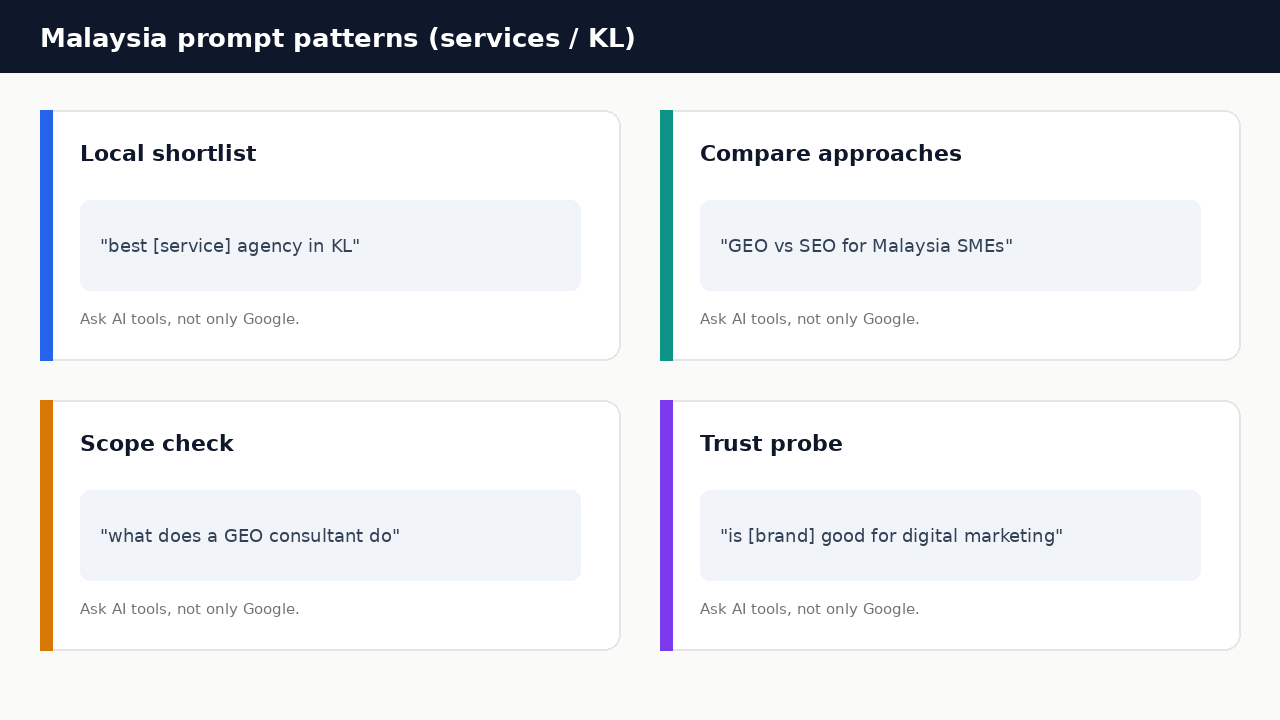
Local service categories in Kuala Lumpur are prompt-heavy. People ask for shortlists (“best [service] agency in KL”), comparisons (“GEO vs SEO for an SME”), scope checks (“what does a GEO consultant even do”), and quiet trust probes (“is [brand] solid for digital marketing Malaysia work?”).
Those prompts rarely match a single money keyword. They fan out. One question becomes three follow-ups. If your site only answers the narrow commercial phrase and leaves related questions thin, models have less clean text to lift. Teams doing SEO work in Kuala Lumpur still need strong foundations; they also need pages that survive being summarised.
One more Malaysia quirk: bilingual and mixed-language research. A buyer might start in English, switch to Bahasa Melayu slang in chat, then Google a brand name they heard in an AI reply. Your naming, NAP consistency, and About copy need to survive that messy path.
A short practical checklist
- Run a small prompt set weekly. Ten to fifteen questions for your category and brand. Note citations and accuracy, not just “mentioned / not mentioned.”
- Fix the boring SEO base first. Crawl errors, thin overlapping pages, and muddy internal links make GEO harder, not easier.
- Rewrite a few money pages for extractability. Open with the answer. Define terms. Cover the adjacent questions people ask after the first one.
- Clean entity signals. Same brand name everywhere, clear service geography (KL vs nationwide), and About copy that matches how customers describe you.
- Add corroboration you would trust yourself. Third-party context beats adjectives. Models are not impressed by “leading” claims with no backup.
A plain explainer on how generative engine optimisation works, useful before you rewrite anything.
What to try this quarter
Pick one category, one city focus (KL is enough to start), and one reporting habit: a shared doc of prompts plus screenshots of AI answers every two weeks. Pair that with a short rewrite sprint on two or three pages. If you need a wider view of how agencies frame digital marketing in Malaysia alongside search work, read for definitions, not for a pitch.
You do not need a new dashboard religion. You need proof that the answers people actually read still recognise you. Rankings remain part of that story. They are no longer the whole story, and pretending otherwise is how good SEO reports quietly lose touch with demand.